
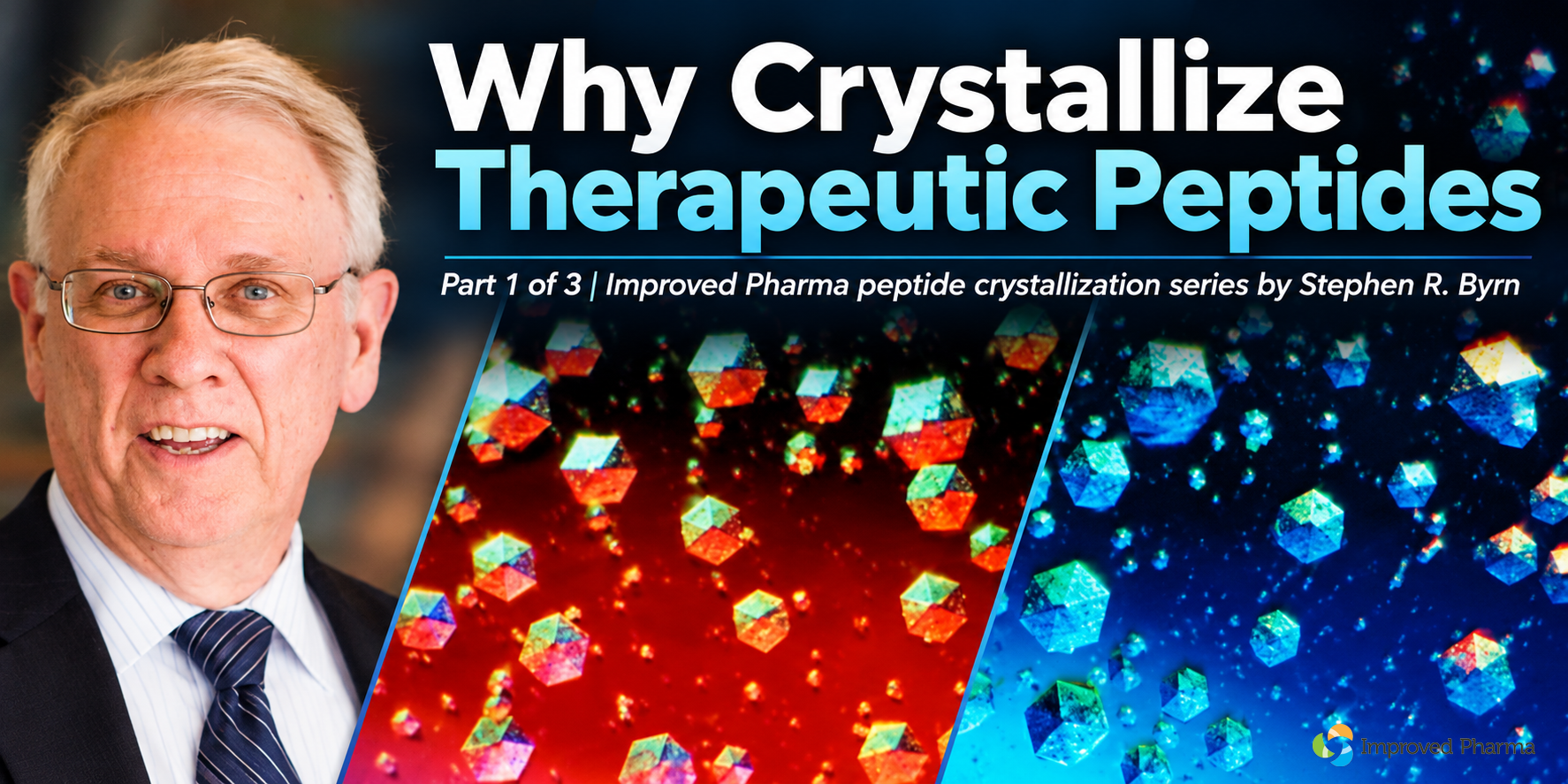
Part 1 of 3 | Improved Pharma peptide crystallization series by Stephen R. Byrn
Peptide medicines have moved far beyond insulin. They now include treatments for metabolic, endocrine, gastrointestinal, and other diseases. Yet for many approved therapeutic peptides, the public literature says remarkably little about the solid form of the isolated drug substance. A peptide may be isolated as an amorphous powder, formulated in solution, or reported as a crystalline solid without a published diffraction pattern. Those are different situations. Each leaves a different question for the scientist developing the next formulation.
Crystallization offers a way to purify a peptide, control its solid form, and sometimes change how a formulation performs. It is an opportunity to investigate, not a guarantee of greater stability or a longer-acting medicine. Insulin shows that pharmaceutical peptide crystals can matter greatly. More recent examples show that useful crystalline forms can also be found among smaller and more complex peptides.
What can a peptide crystal accomplish?
In a crystallization process, molecules assemble into an ordered lattice. Impurities may remain preferentially in solution, so a well-designed process can improve purity and simplify isolation. Crystal size and shape can affect filtration, drying, powder handling, and the ability to make a reproducible suspension. The magnitude of each benefit depends on the peptide and the process; crystallization can also trap impurities or produce crystals that are difficult to handle.
A crystalline drug substance may behave differently from an amorphous one during storage. The distinction deserves measurement rather than assumption. Water uptake, lattice changes, chemical degradation, and aggregation can vary with the particular salt, hydrate, and storage conditions. Linaclotide patents, for example, report crystalline forms and compare their stability with amorphous material. Patent results are useful leads, but a new development program should reproduce the comparison under conditions relevant to its own product [1].
Crystals can also influence drug release. A poorly soluble crystalline peptide suspension may dissolve gradually after injection, potentially supporting longer exposure or a more concentrated, lower viscosity dose. Dissolution depends on the actual crystal form, particle size, surface area, vehicle, and physiology. A crystal of a peptide is not automatically a viable depot formulation: the release profile and tolerability have to be demonstrated [2].
Why are peptide crystals challenging?
Peptides present many possible interaction sites and often adopt more than one conformation. A change in pH can alter charge; a change in counterion can alter ion pairing; a small change in solvent or water activity can favor another solid form. Concentration, temperature, mixing, and seeding also affect whether a solution yields crystals, amorphous precipitate, or gel. The same peptide may form a hydrate, solvate, or several distinct crystalline phases.
Counterion selection is therefore part of the experiment. Peptides isolated after synthesis or chromatography may carry trifluoroacetate, acetate, chloride, or another counterion. Changing that counterion can alter solubility and crystallization behavior, but it does not by itself establish crystallinity. The form must be isolated and characterized. Moore and colleagues examined how TFA and chloride salts affect peptide hydrogels: useful evidence that counterions matter, although a hydrogel is not a peptide crystal [3,4]. Likewise, a receptor-bound peptide structure does not establish a crystal form of the isolated drug substance.
How do we know a peptide is crystalline?
Light microscopy can reveal needles, plates, and other promising particles. Polarized light microscopy provides stronger evidence: the USP ⟨695⟩ crystallinity test refers to the procedure in ⟨776⟩, which examines particles for birefringence (interference colors) and extinction positions as the stage is rotated, when a drug-substance monograph specifies a crystallinity requirement [5,6]. This is a valid qualitative test for crystallinity. It does not, by itself, identify the chemical composition of the particles. X-ray powder diffraction (XRPD) provides a characteristic pattern for comparing batches and differentiating crystal forms [7]. Single crystal diffraction, when suitable crystals can be grown, can reveal molecular packing and unit cell details. Raman spectroscopy, solid state NMR, thermal analysis, water measurements, and chemical assays provide complementary information. For a candidate form, a strong development record combines a reproducible preparation with suitable evidence of crystallinity, identity, purity, water or solvent content, and stability data.
The distinction among drug substance, intermediate, and finished product matters. A crystalline intermediate may disappear during later processing; an API crystal may dissolve when a liquid medicine is made. Conversely, a peptide sold as a solution can still have useful crystalline forms for purification, storage, or future formulation development. Publicly documented crystal forms should not be taken as an exhaustive count of which marketed peptides are crystalline.
A practical development approach
A focused program begins by confirming molecular identity and establishing a solubility map over relevant pH and concentration ranges. Counterion, solvent, antisolvent, temperature, and precipitant screens can then be chosen using experience with related peptides. Initial microvolume experiments conserve scarce material. Promising particles are examined by polarized light microscopy, then characterized further as needed by diffraction and chemical analysis before larger scale experiments address yield, crystal form consistency, filtration, drying, and stability.
At Improved Pharma, our interest is in using molecular structure and prior crystallization experience to prioritize experiments, then letting careful solid-state measurements decide what has actually formed. That approach is especially valuable when the available material is limited and a new peptide has no published crystal form. In the subsequent blogs, insulin and low molecular weight peptides provide proven examples, while GLP-1 drugs illustrate how much remains to be learned.
Selected references
[1] Sanghvi R et al. Crystalline form of linaclotide. US Patent 8,222,201. https://patents.google.com/patent/US8222201B2/en
[2] Holm R et al. Long-acting injectable aqueous suspensions: summary from an AAPS workshop. AAPS J. 2023;25:49. https://doi.org/10.1208/s12248-023-00811-8
[3] Sikora K et al. The role of counter-ions in peptides: an overview. Pharmaceuticals. 2020;13:442. https://doi.org/10.3390/ph13120442
[4] Moore JV et al. Impact of counterion and salt form on the properties of long-acting injectable peptide hydrogels for drug delivery. Faraday Discuss. 2025;260:215-234.
[5] USP–NF ⟨695⟩ Crystallinity. doi:10.31003/USPNF_M99455_01_01.
[6] USP–NF ⟨776⟩ Optical Microscopy. doi:10.31003/USPNF_M99565_01_01.
[7] USP–NF ⟨941⟩ XRPD. doi:10.31003/USPNF_M99730_02_01.