
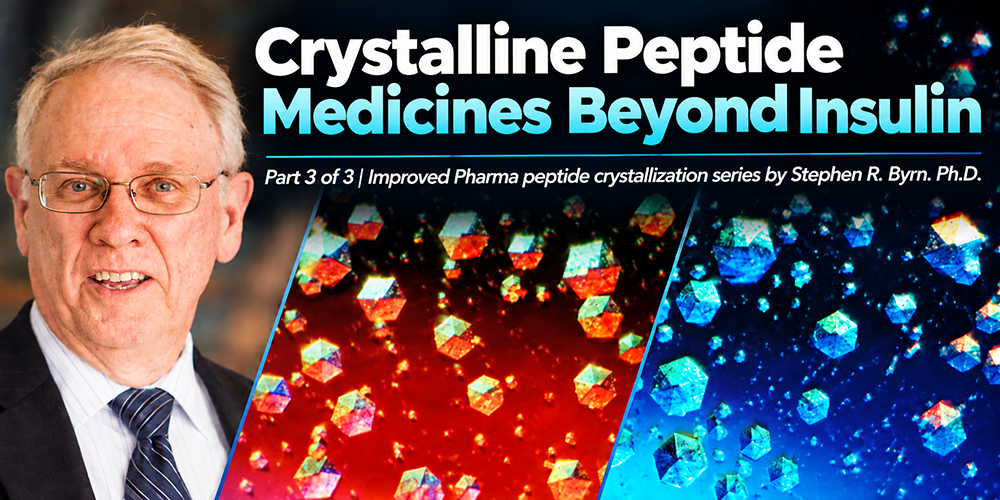
Part 3 of 3 | Improved Pharma peptide crystallization series by Stephen R. Byrn. Ph.D.
Crystalline peptide medicines extend well beyond insulin. Some marketed molecules have solved structures of the isolated drug; others have only powder diffraction evidence for particular solid forms. The examples below range from peptide hormones and cyclic peptides to peptide-containing antibiotics. Their chemistries differ, but each shows why molecular identity, crystal form, and the nature of the X-ray evidence must be stated separately.
Octreotide offers two structure determinations of the same form
Octreotide is an eight-residue cyclic somatostatin analogue. A single-crystal X-ray structure was reported in 1995. A later study obtained a structural model from high-quality X-ray powder data on polycrystalline octreotide [1,2]. This is an example of an isolated therapeutic peptide for which structural information can be obtained even when large single crystals are difficult to grow.
A separate patent describes a poorly soluble octreotide pamoate salt for sustained release [3]. Salt selection can change dissolution rate, but that patent should not be used to imply that the pamoate formulation contains the same crystal form as either published octreotide structure.
Linaclotide and trofinetide show different levels of solid-form evidence
A linaclotide patent reports crystalline forms distinguished by X-ray powder diffraction and compares their properties with amorphous material [4]. This documents candidate crystalline drug-substance forms, without providing a solved atomic crystal structure in the cited patent.
For trofinetide, the N-terminal tripeptide of insulin-like growth factor 1, a patent describes Form A with XRPD, Raman, solid-state NMR, thermal and water measurements, and a single-crystal X-ray structure [5]. The structure contains three water molecules per trofinetide molecule. This is an especially useful example of how hydration belongs in the definition and control of a peptide crystal form.
Enlicitide shows how a marketed macrocyclic peptide can have several salts
Enlicitide, the macrocyclic PCSK9 inhibitor marketed in the United States as Lipfendra, has a solid-form patent describing crystalline acetate, caprate (decanoate), lactate, succinate, tartrate, and sulfate salts [6,7]. The patent gives XRPD fingerprints and a seeded process yielding hundreds of grams of its Caprate 3 form. It reports humidity-dependent behavior for some caprate forms. This is persuasive evidence of crystalline material of the final decanoate drug salt, although the cited patent should not be represented as a solved single-crystal atomic structure.
A separate manufacturing paper describes biocatalytic steps and purification in the synthesis of enlicitide [8]. The manufacturing paper and the solid-form patent answer different questions; both are useful, provided the claims are kept distinct.
Cyclosporine A and romidepsin broaden the cyclic peptide examples
Cyclosporine A is a marketed cyclic undecapeptide with extensive N-methylation. Loosli and colleagues reported an all-light-atom X-ray crystal structure of cyclosporine A itself, rather than a cyclophilin-bound complex [9]. Its conformation and solid-state packing illustrate the diversity of cyclic peptide structures beyond the hormone analogues.
Romidepsin, a marketed cyclic depsipeptide anticancer drug, provides a strong pharmaceutical solid-form example. US Patent 9,624,271 describes XRPD patterns and single-crystal X-ray data for several romidepsin forms [10]. Form C is a nonstoichiometric hydrate with one fully occupied water site and a second site at approximately 73% occupancy. The precise hydration state should be considered when reproducing the reported form.
Peptide antibiotics offer additional structural precedents
Vancomycin is a marketed glycopeptide antibiotic. Schäfer and colleagues solved the crystal structure of vancomycin itself at atomic resolution; PDB 1SHO is an isolated-drug structure, rather than a complex with its bacterial target [11]. Its crosslinked aromatic peptide and sugar groups make it chemically different from linear therapeutic hormones, but it is a valid example of a peptide-derived medicine with a solved crystal structure.
Gramicidin S is a cyclic decapeptide antibiotic used in topical products in some markets. A 2019 paper reports an X-ray structure of gramicidin S dihydrochloride at 1.1 Å resolution [12]. The counterion is part of the named crystalline material: the result should be called a structure of gramicidin S dihydrochloride, rather than assumed to apply to every salt or dosage form. We have not established that gramicidin S itself is an FDA-approved U.S. medicine.
Dactinomycin, also called actinomycin D, is a marketed chromopeptide anticancer antibiotic. It contains two cyclic pentapeptide lactone portions attached to a nonpeptide phenoxazone chromophore. Its isolated-drug X-ray structure was published in 1998 and deposited as PDB 1A7Y [13]. It belongs here as a peptide-containing natural product, rather than as a simple peptide hormone.
What these structures do and do not establish
A solved structure proves that a specified molecular species formed an ordered crystal under the reported conditions. An XRPD pattern can establish a reproducible crystalline phase without revealing every atomic position. Neither observation alone proves that the marketed dosage form contains those crystals, that the same form is made commercially, or that crystallization improves stability or delivery.
Together, these examples support a practical approach: verify the exact peptide or peptide-containing molecule, identify its salt and hydration state, isolate and characterize candidate forms, and then test whether any form improves purification, handling, stability, or release. The advantage must be measured for the particular molecule and intended product.
Selected references
[1] Pohl E et al. Structure of octreotide, a somatostatin analogue. Acta Crystallogr D. 1995. https://pubmed.ncbi.nlm.nih.gov/15299335/
[2] Revisiting the structure of a synthetic somatostatin analogue for peptide drug design. Acta Crystallogr D. 2020. https://pubmed.ncbi.nlm.nih.gov/32830718/
[3] CA2535463A1. Octreotide pamoate slow release compositions. https://patents.google.com/patent/CA2535463A1/en
[4] US8222201B2. Crystalline form of linaclotide. https://patents.google.com/patent/US8222201B2/en
[5] US11827600B2. Crystalline forms of trofinetide. https://patents.google.com/patent/US11827600B2/en
[6] FDA. Lipfendra approval and labeling, 2026. https://www.fda.gov/drugs/novel-drug-approvals-fda/novel-drug-approvals-2026
[7] WO2024040125A1. Crystalline forms of a PCSK9 inhibitor, compositions and uses. https://patents.google.com/patent/WO2024040125A1/en
[8] Klapars A et al. Biocatalytic cascades enable manufacture of the macrocyclic peptide enlicitide. Science. 2026;392:643–647. https://doi.org/10.1126/science.aed8713
[9] Loosli HR et al. Peptide conformations. Part 31. The conformation of cyclosporin A in the crystal and in solution. Helv Chim Acta. 1985;68:682–704. https://doi.org/10.1002/hlca.19850680319
[10] US9624271B2. Romidepsin solid forms and uses thereof. https://patents.google.com/patent/US9624271B2/en
[11] Schäfer M et al. Crystal structure of vancomycin. Structure. 1996. https://pubmed.ncbi.nlm.nih.gov/8994975/ ; PDB 1SHO: https://www.rcsb.org/structure/1SHO
[12] Crystal Structure of Gramicidin S Hydrochloride at 1.1 Å Resolution. X-ray Structure Analysis Online. 2019;35:1–2. https://www.jstage.jst.go.jp/article/xraystruct/35/0/35_1/_article
[13] Schäfer M et al. Crystal Structures of Actinomycin D and Actinomycin Z3. Angew Chem Int Ed. 1998;37:2381–2384. https://pubmed.ncbi.nlm.nih.gov/29710967/ ; PDB 1A7Y: https://www.rcsb.org/structure/1A7Y